Calcite - Twinned and Untwinned Scalenohedra
Based on specimens from Ohio and Tennessee
One of the most distinctive forms that calcite takes is the scalenohedron, recognizable by its alternating pairs of faces with steeper and shallower intersections, all meeting in the center to produce an equatorial zigzag. Although there are many possible scalenohedra, ranging from squat to extremely pointy, the form {21.1} is the most common. Both of these models represent that form. One shows the scalenohedron alone, and the other shows an idealized twin of the same form on (00.1).
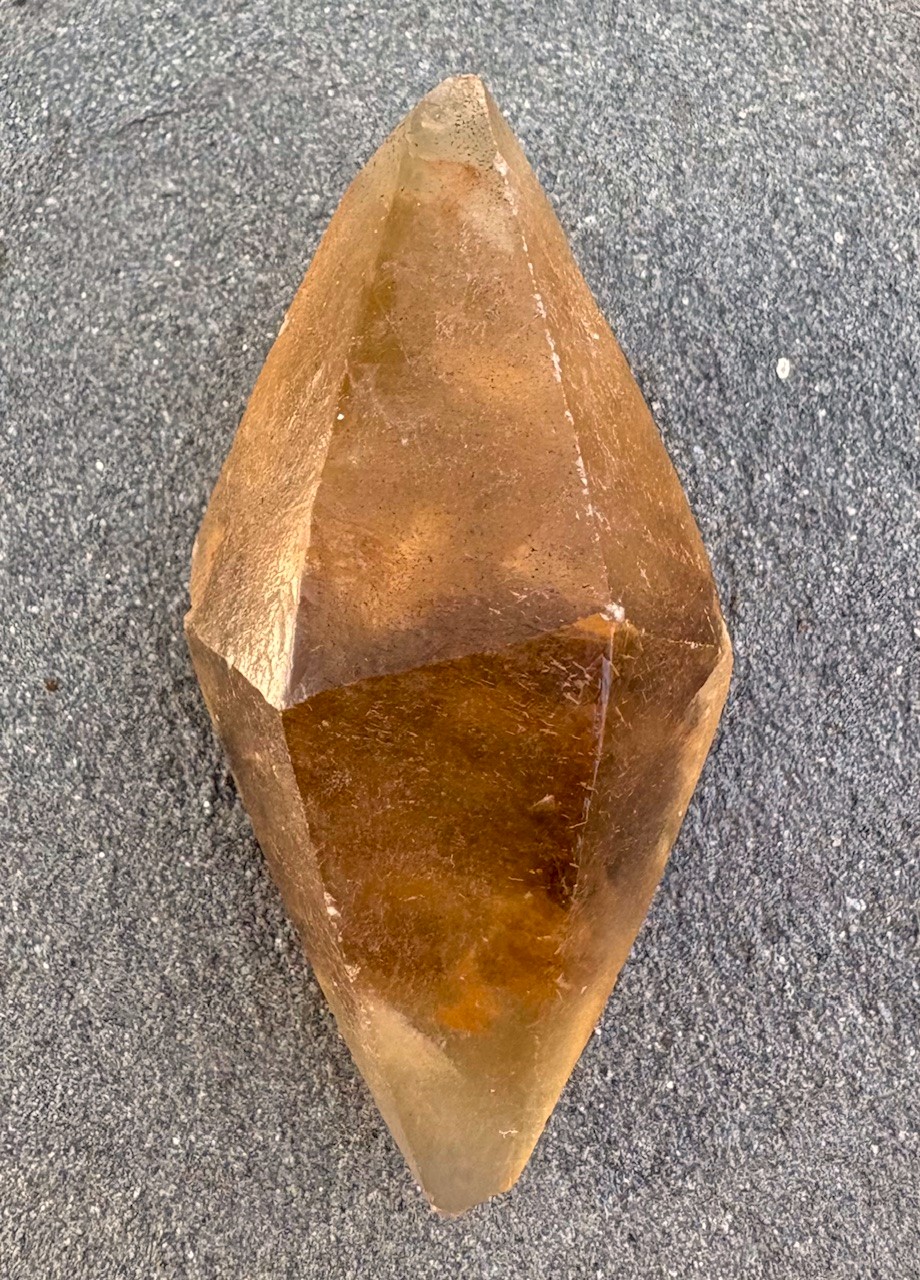
Here is the untwinned scalenohedron model, shown next to a single crystal in the same orientation. The faces of the crystal are slightly
curved, giving it a rounded look. You can see that the pair of faces near the top left of the model have a shallower intersection than
the pair of faces at the top right. The situation is reversed at the bottom of the crystal, causing a sharper angle to meet a shallower one.
That’s what causes the zigzag of edges around the center of the model. Seeing that pattern is a sure way to identify a scalenohedron.
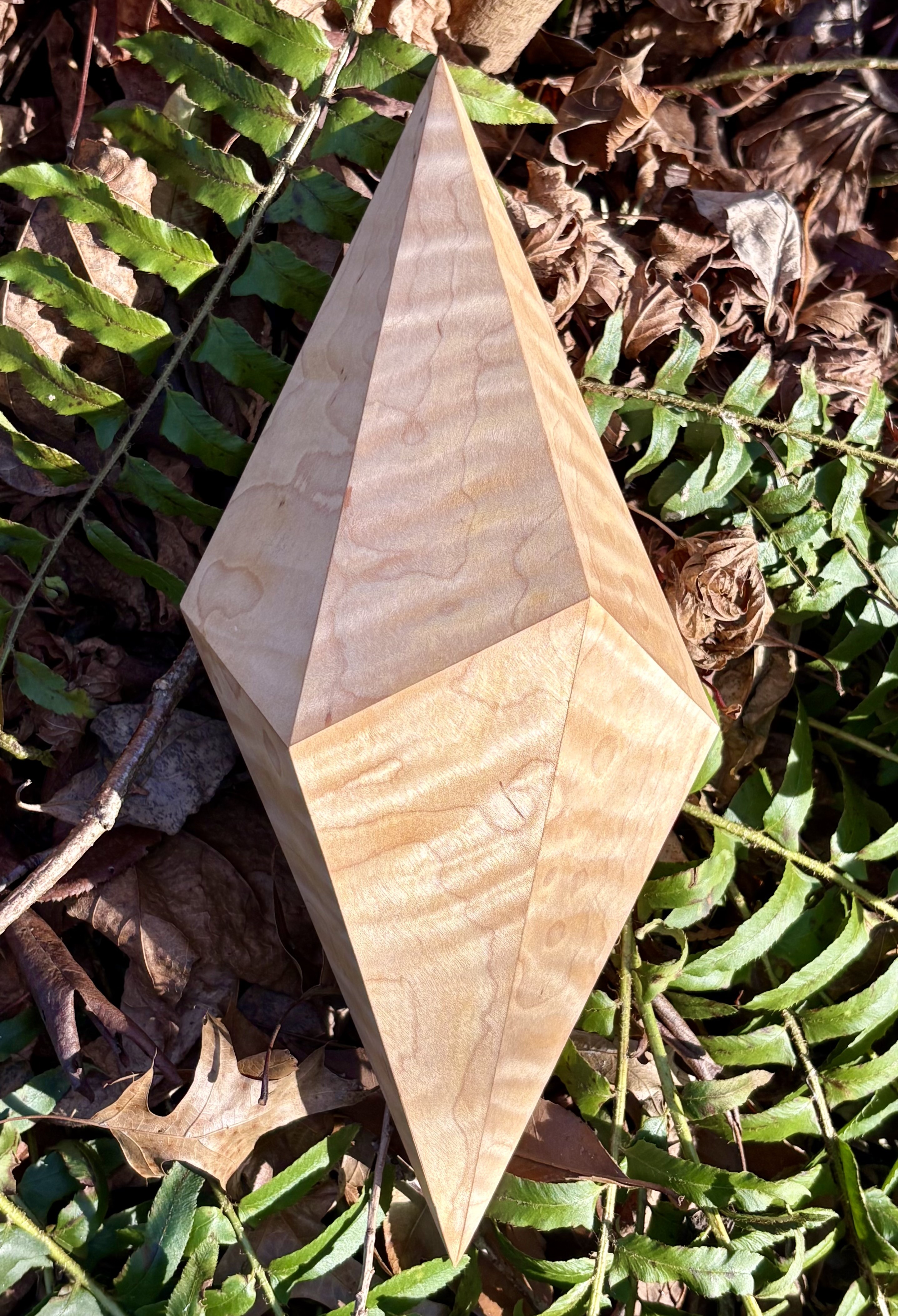
And here is the twinned scalenohedron model, shown next to a twinned crystal. (The top of the crystal isn’t broken, the crystal is just distorted to look that way) If you look at the paired steep and shallow faces here the same way you did with the untwinned scalenohedron, you’ll see that the top and bottom of the crystal are no longer reversed - shallow angles on the top meet shallow angles on the bottom.
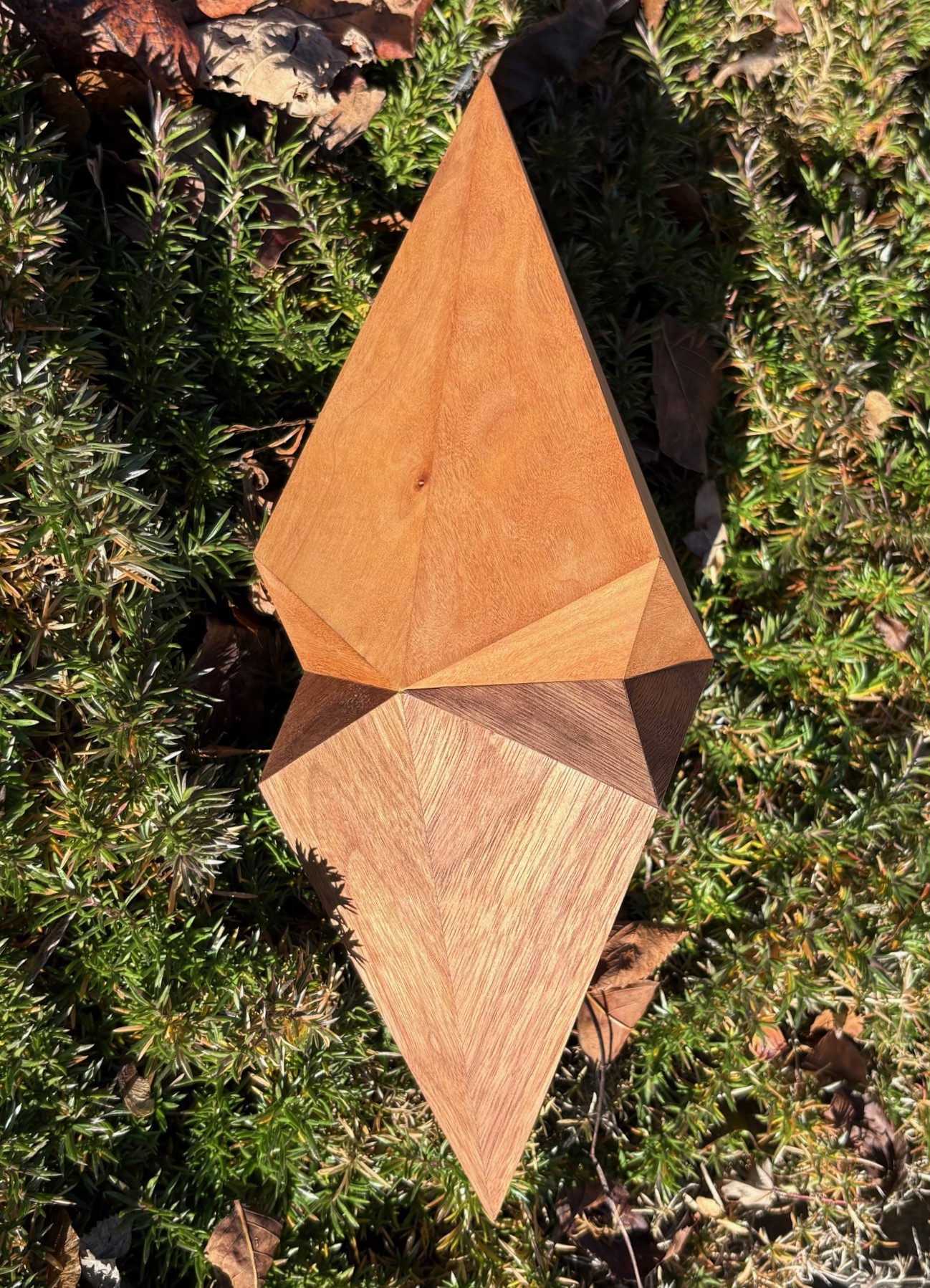
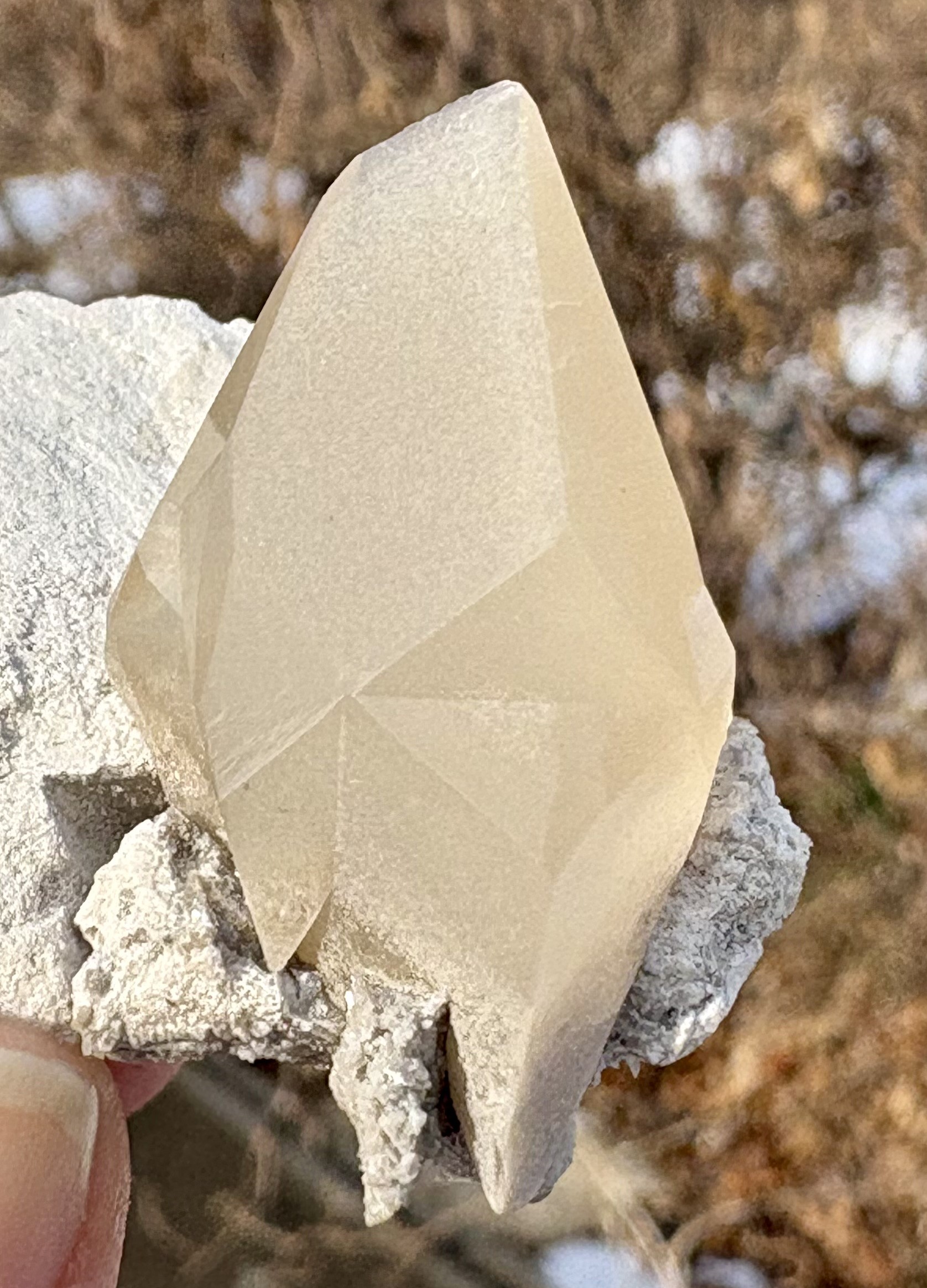
This model of a twin is designed to be in perfect proportion so that the reentrant angles are as large as possible, making the twin very obvious. It also maximizes the difficulty of the model, putting multiple convex and concave areas together at one point. I was lucky to have a matching crystal, but in most real twinned scalenohedra, the shallow angles don’t meet at precise points, but rather in horizontal line segments. Reentrant angles are often smaller but usually still quite visible. But sometimes, if crystal growth has filled in the reentrant angles completely, the equatorial zigzag can be erased entirely, leaving a horizontal line around the center of the crystal. When that happens, finding alternating pairs of steep and shallow faces that aren’t offset between top and bottom is the best way to determine that the crystal is a twinned scalenohedron. I don’t have a model of this configuration (yet), but here’s a photo of crystal doing almost exactly that.
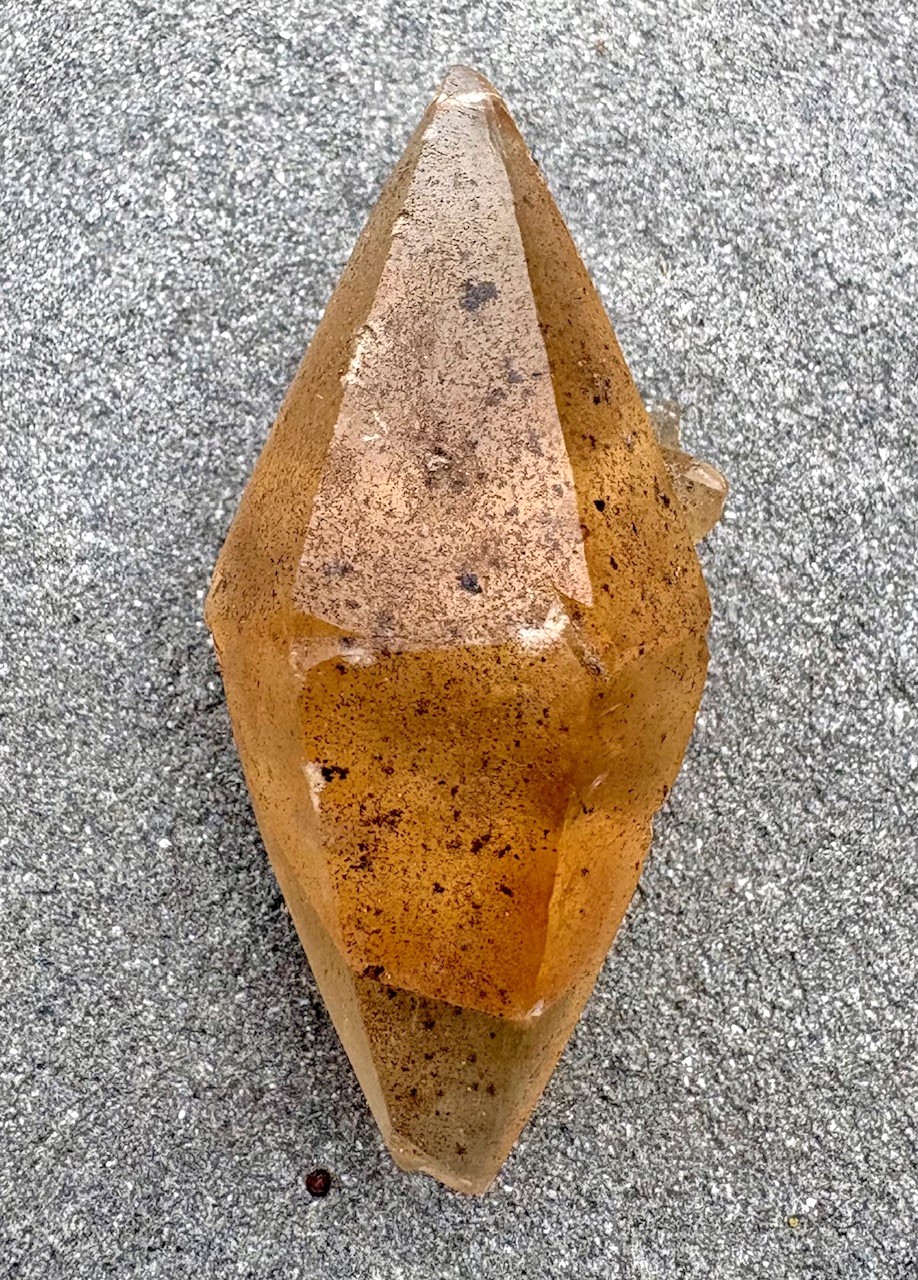
There is a tiny bit of reentrant angle visible towards the left side of the crystal.
If you’d like to see another calcite model based on a scalenohedron, you can find it here
And if you’d like to see another model of a twin with lots of reentrant angles that meet at points, the iron cross twin is the most complex I’ve made yet. Have a look at it here
Model details: Untwinned scalenohedron is 10" long. Curly maple. Twinned scalenohedron is 12" long. Big leaf maple and black walnut.
Specimen details: The untwinned calcite scalenohedron and the fully twinned single twinned crystal are both from Pugh Quarry, Weston, Wood Co. OH. Both 5 cm.
The twinned scalenohedron on matrix is from Cumberland Mine, Smith Co., TN. Crystal is 4.6 cm.