Staurolite Fairy Cross Twin
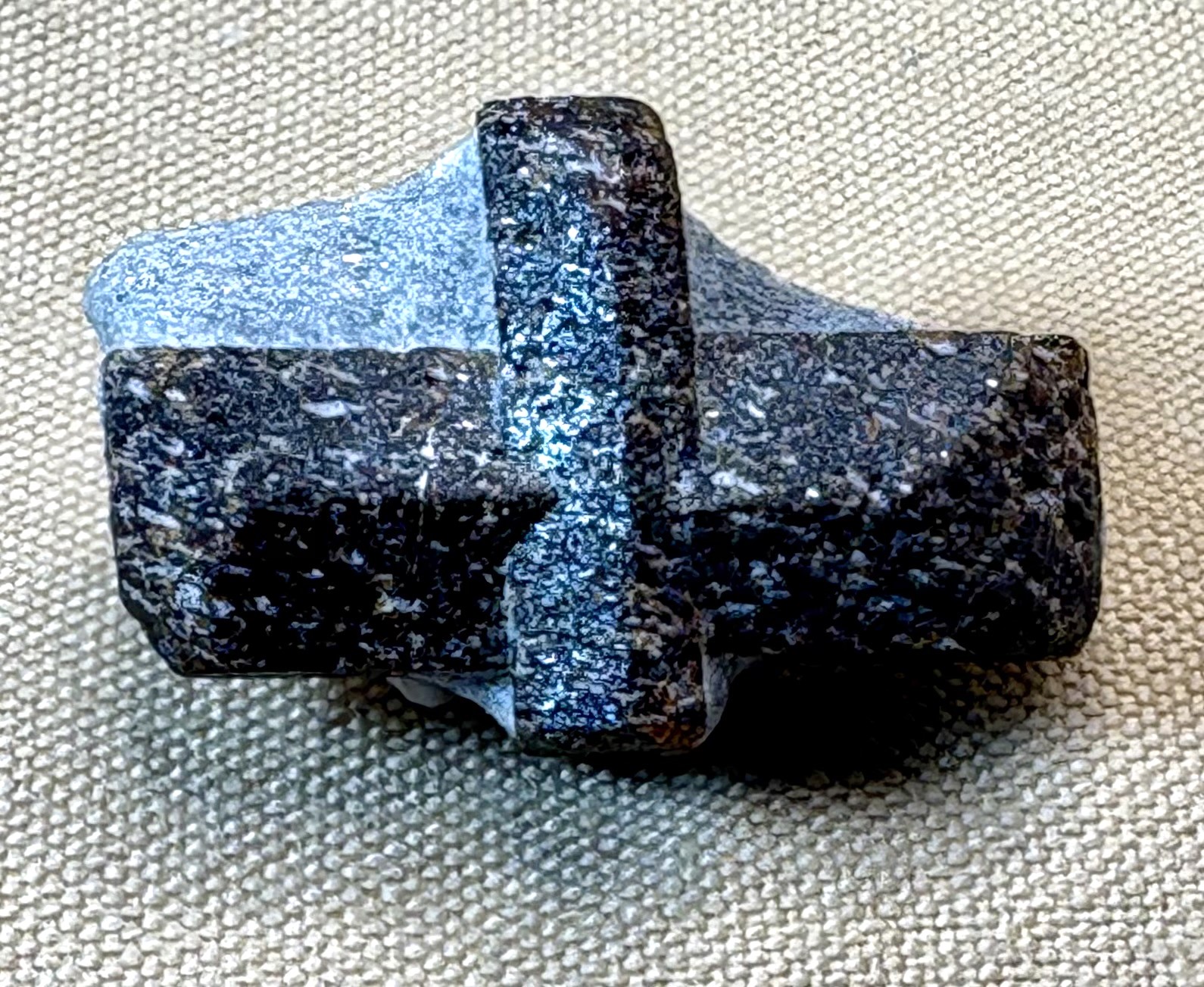
Based on a specimen from Semiostrovie (Sevev Islands), Russia.
When I was a kid, every attraction with any kind of geologic connection (museums, national parks, commercial caves) had a basket of staurolite fairy crosses for sale in the gift shop. Some of them were probably fakes, some of them were “improved” by a little judicious carving, and some of them had cheap findings glued to one end to turn them into pendants. I never bothered to buy one back then, because they seemed cheesy and incredibly common. Lately however, a well formed fairy cross is a little harder to come by. I’m keeping my eye out at mineral shows for a specimen that more closely resembles the form of the crosses I remember from my childhood, but this one from Russia will do nicely for now.
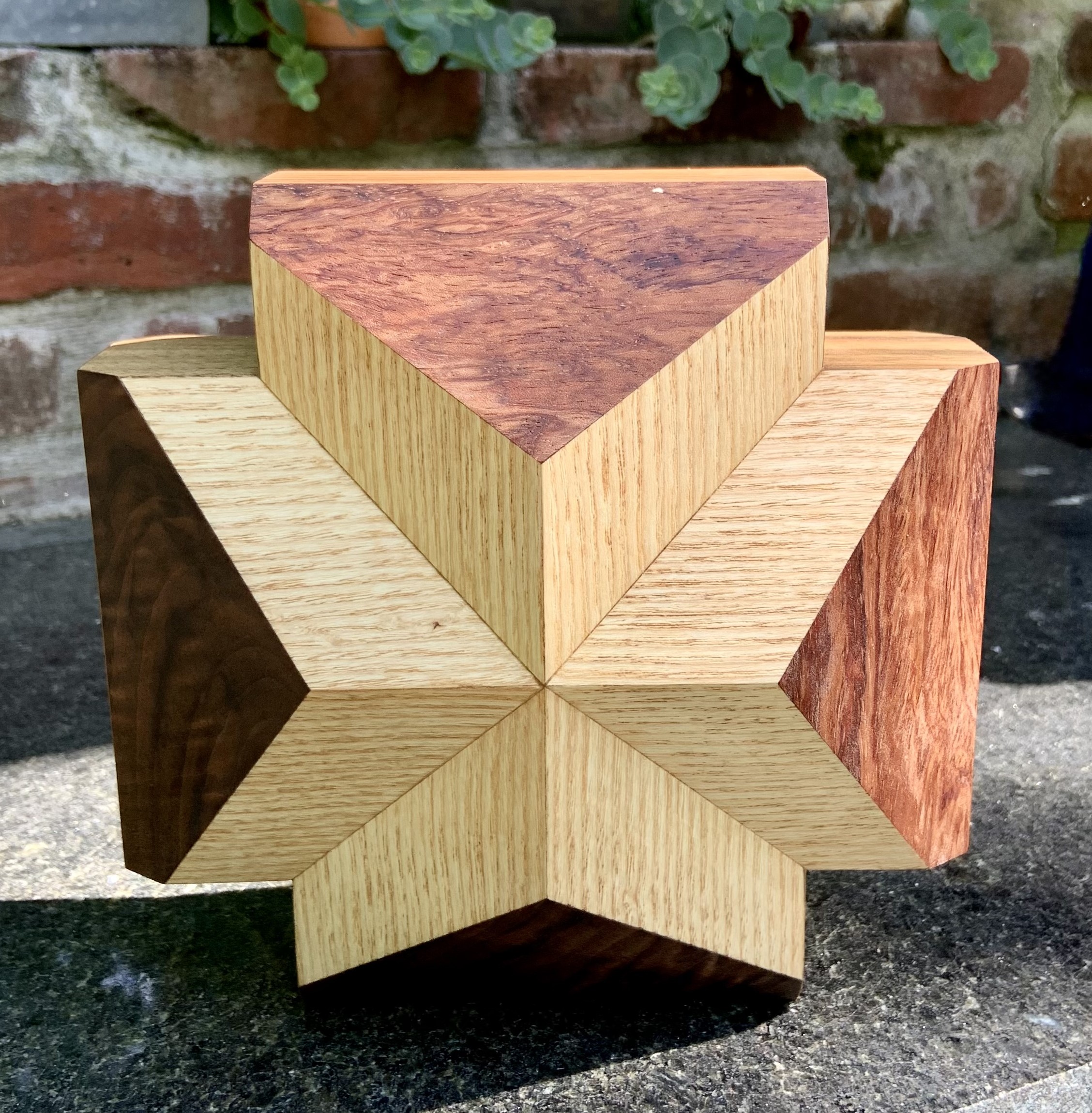
Staurolite twins according to a few different twin laws. Twins on (231) that form a nearly 60 degree angle are common, while the almost 90 degree twins on (031) are a bit less common. I have a box of 60 degree twins (including one very nice repeated twin with 3 members that I hope to make a model of in the near future) but only two crosses. Although staurolite is monoclinic, I modeled it as if it was orthorhombic, since the beta angle is 90.45 degrees. I think such a small difference would not be detectable in a small model anyway, and the practical benefits were significant!
I’ve made this model in two different sizes. Many of my models could be resized upon request, so let me know if you’re interested in a larger or smaller version.
Model details: Large staurolite model - 7.5" high. Prism faces are ash. Pinacoid faces are black walnut, bubinga, English walnut, and red oak.
Small staurolite model - 6" high. Prism faces are shedua. Pinacoid faces are birdseye maple, canary, yellowheart, and bubinga.
Specimen details: Staurolite cross twin. Semiostrovie (Sevev Islands), Keyvy, Kola, Russia. Longer crystal is 3 cm.